The Ultimate B2B Sandpaper & Sanding Disc Buying Guide
The Ultimate B2B Sandpaper & Sanding Disc Buying Guide
In industrial surface preparation—whether automotive refinishing, woodworking, or metal fabrication—sanding discs and abrasive paper are critical components. For B2B buyers, choosing the right product impacts labor efficiency, finish quality, throughput, and cost. This guide covers everything procurement managers, distributors, and workshop owners need to know before placing their next order.
1. Grit Alone Doesn’t Tell the Whole Story
The grit number indicates coarseness but does not define cutting power, lifespan, or heat resistance. These are determined by grain composition and bonding method.
Common Abrasive Materials:
| Material | Characteristics | Use Cases |
|---|---|---|
| Aluminum Oxide | Durable, affordable, versatile | General-purpose sanding |
| Zirconia Alumina | Cool cutting, self-sharpening edges, long life | Heavy stock removal on metals |
| Ceramic Alumina | Hardest grain, high heat resistance, aggressive cutting | High-pressure applications, paint removal |
B2B Tip: Match abrasive material to workflow. Coarse ceramic discs can outperform cheap fine aluminum oxide in demanding applications.
2. Backing Type Dictates Durability and Flexibility
The backing material affects flexibility, tear resistance, and sanding consistency.
| Backing Type | Features | Typical Use |
|---|---|---|
| Paper | Cost-effective, limited flexibility | Dry sanding, low-pressure tasks |
| Film | Tear-resistant, even surface contact | Automotive bodywork, fine finishing |
| Cloth | Strong, flexible, high durability | Industrial grinding, curved parts |
3. Hook & Loop vs PSA: Choose Based on Workflow
- Hook & Loop (Velcro): Fast disc changes, ideal for shops switching grits frequently.
- PSA (Pressure-Sensitive Adhesive): Stable contact, preferred for uninterrupted production runs.
Quick Decision Rule: Use Hook & Loop for versatility; PSA for stability and high-throughput operations.
4. Dust Extraction Compatibility
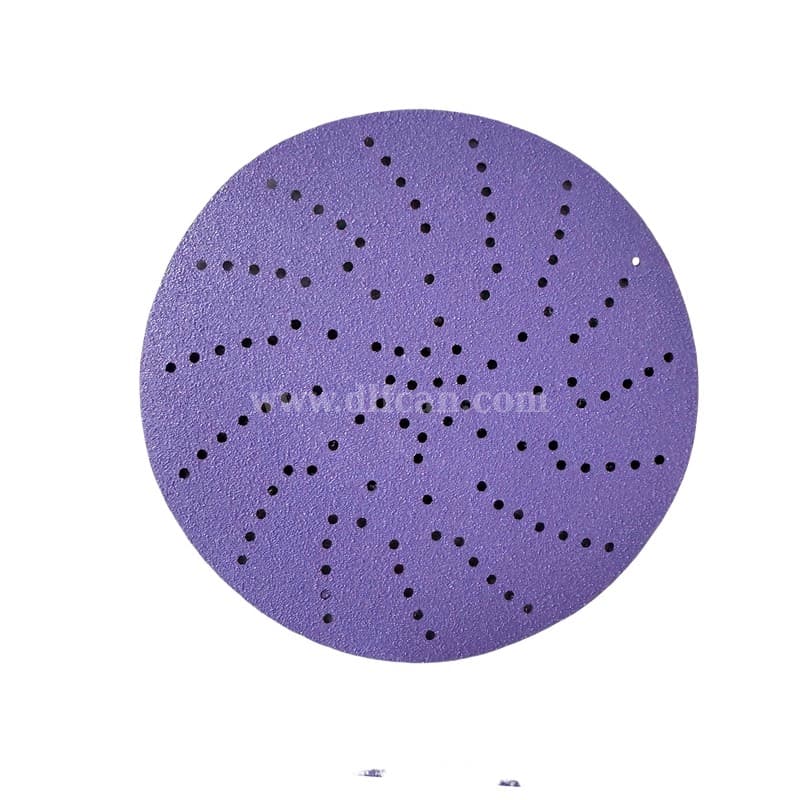
Disc hole patterns (6-hole, 8-hole, multi-hole) must match sander pads. Mismatches reduce suction efficiency by 40%+, shorten disc life, and may void warranties.
Image Suggestion: Diagram of sanding disc hole patterns matched to orbital sander pad
5. Disc Formats and Sizes
| Disc Type | Best For |
|---|---|
| Standard Round Discs | General surface sanding |
| Fiber Discs | Heavy grinding on metal |
| Surface Conditioning Discs | Blending, finishing without gouging |
| Quick Change (Roloc) | Tight spots, tool-free replacement |
Sizes: 5” and 6” dominate automotive and woodworking; 7”+ used in industrial fabrication.
6. Grit Progression for Optimal Workflow
Follow a structured grit sequence to reduce scratches and minimize labor:
| Step | Grit | Purpose |
|---|---|---|
| 1 | 80 | Filler shaping |
| 2 | 120–150 | Rough leveling |
| 3 | 220–240 | Primer sanding |
| 4 | 320–400 | Final finish before paint |
7. Performance vs Cost
Low-cost discs often wear out faster, increasing labor and rework costs. Evaluate total cost per completed task rather than per disc.
8. Bulk Buying & OEM Customization
- Volume discounts for repeat orders or case quantities.
- OEM branding: custom labeling, packaging, grit ranges.
- Vendor reliability: consistent supply, quality assurance, lead times.
9. Usage Practices to Protect Investment
- Avoid excessive pressure—let the abrasive do the work.
- Match speed and pressure to backing type.
- Replace worn discs early to prevent surface defects.
10. Sustainability & Industry Trends
- Low-VOC or solvent-free binders.
- Recyclable packaging.
- ISO or REACH compliant sourcing.
- Abrasive recycling programs or low-carbon manufacturing lines.
11. B2B Sanding Disc Buying Checklist
| Criteria | What to Check |
|---|---|
| Abrasive Material | Aluminum oxide, zirconia, ceramic—match to application |
| Grit Range | Ensure coverage (e.g., 80–400 grit sets) |
| Backing Type | Durability, flexibility, and surface conformity |
| Hole Pattern | Confirm compatibility with sander pad |
| Disc Size & Format | Align with sander type and job requirements |
| Attachment Method | Hook & Loop for versatility; PSA for stability |
| Packaging & OEM Options | Bulk packs, private label, storage efficiency |
| Vendor Reliability | Delivery consistency, QC documentation |
| Sustainability | Recyclable materials, low VOC, eco-friendly manufacturing |
Final Word
Sanding discs are not a trivial expense. They influence throughput, finish quality, operator efficiency, and long-term cost. For B2B buyers, selecting the right disc requires understanding material, backing, grit progression, attachment method, hole pattern, and vendor reliability.
Ready to Optimize Your Abrasives Supply?
DLF Can provides industrial-grade sanding discs with:
- Ceramic, zirconia, and aluminum oxide options
- Hook & Loop and PSA formats
- OEM custom packaging for distributors
- Multi-hole dust extraction patterns
- Global fulfillment and bulk pricing